Advertisement
From the archives, January/February 2004:
“Let me live. And I’ll make it worth your while.” That’s the deal 16-year-old Tom Andrews cut with God.
The year was 1969, and Andrews—now 50, a former member of Congress, and the national director of Win Without War, a coalition of forty-two groups opposing U.S. preemptive military intervention—was a high school sophomore in Easton, Massachusetts, where his family ran a poultry farm. He had been elected class president and played several sports.
That spring an accidental clash with a glass door landed him in the emergency room. He mentioned to his doctors that his knee had been swollen since football season. They found a malignant tumor. “There I was, a young athlete and good student facing death,” Andrews remembers. “It’s the kind of experience that shakes you to your foundations. Lying in my hospital bed, I found myself looking at older people and thinking, ‘Why me and not them?’ I started asking, ‘What is the point to my being here, to life itself?’”
So Andrews made his deal with God. Doctors amputated his leg. He now walks with a prosthesis and a noticeable limp. “I’ve been trying to keep up my end of the bargain ever since—and she’s kept hers,” quips Andrews, who grew up in an evangelical Congregational church and has been a member of the First Parish Unitarian Universalist in Portland, Maine, since his thirties.
His experience with cancer transformed a young man whose main concerns were football, friends, and 4-H money-making projects into Teen Superorganizer. While still in high school he started a drop-in recreation center that hooked up urban orphans with teen mentors. He organized 5,000 students to walk twenty-five miles and raised $60,000 for social causes. An earlier walk he organized raised $40,000 .
“I got a real taste of what was possible,” Andrews says. He and allies used the money to start a drop-in center for the elderly and an agricultural project in Guatemala. With a sheepish “Hey, it was the '60s” kind of grin, he admits to the name he gave his first nonprofit: Project SOUL, for Students Offering Universal Love.
The name does have a certain dated charm. But Andrews’s belief in the power of common people when they speak what’s in their hearts is abiding. It’s the thread that runs through his career in nonprofit advocacy work and electoral politics.
For three decades Andrews has been at the forefront of movements for peace, disabled people’s rights, nuclear waste issues, land mine control, emerging third world democracies, tax reform, neighborhood revitalization, and access to health care and education. He represented Maine in Congress from 1990 to 1994 and founded New Economy Communications in 1998 to help get progressive economic thinkers’ ideas into the media. The Washington-based organization, where he still serves as president, has expanded its focus to human rights and economic justice. Its current clients include the democratically elected Burmese government in exile, anti-sweatshop activists, as well as Win Without War, which he also directs.
Andrews has become known as a sort of David who can take an idea, hurl it at a Goliath-size problem in the world, and hit his mark, getting more bang for the effort than seems possible. He strikes a balance between keeping focused on his long-term objective—currently to thwart the Bush Doctrine of preemptive and unilateral military intervention—and executing step-by-step actions that move toward the objective while empowering his supporters. Colleagues say that brainstorming sessions with him are like fireworks and that when Andrews looks you in the eye and asks you to help, it’s impossible to say no.
“Tom has, in a secular way, what those of us in the religious community understand as vocation,” says the Rev. Dr. Bob Edgar, general secretary of the National Council of Churches, a Win Without War cofounder, and also a former member of Congress. “Tom’s vocation is to improve the quality of life on planet Earth. That may sound like a grandiose delusion that he needs psychological counseling for. But it’s a passion, and he’s able to leverage the right people in the right places and hit the hot-button issues. It takes a lot of ego, and Tom has a healthy ego. But he also has ego disarmament, which has usually been surgically removed from politicians. He’s able to step back and let others take credit.”
Nothing excites Andrews more than grass-roots organizing. “There is enormous power in the human spirit, more than we realize,” he says. “It can be remarkable when that power is engaged. And that’s the common denominator of all the things I’ve had the privilege to be a part of.”
Andrews was a mastermind behind two of the peace movement’s largest actions opposing the U.S. invasion of Iraq last March.
The Win Without War coalition asked opponents of the invasion to register online for a “virtual march on Washington” and to promise to call their congresspeople on February 26. On an otherwise-quiet, snowy Wednesday, Congress received more than a million calls. “The virtual march exceeded all our expectations,” he says. “You can think strategically, draw on your skills and experience, but then something magic happens. I walked around the Senate that day. Every office was doing nothing but answering these phone calls.”
The Internet has made it possible to organize farther and faster than ever before. The next Friday, with invasion seeming imminent, Andrews hit on the idea of a global candlelight vigil. “On Saturday I came in to the office and thought, ‘This is impossible in a week.’ By Sunday my fellow organizers were calling and saying, ‘Let’s do it anyway.’ And I knew, of course, we had to.”
MoveOn.org, which has become the Web wizard and most public face of the coalition, posted a call to light a candle, wherever you were, at 7 p.m. on Sunday, March 16. “It was unbelievable,” Andrews remembers, “to watch the digital photos coming in to the site, to watch the torch pass to each time zone, starting in New Zealand and ending in the United States.” Nearly 7,000 vigils were held in 140 countries. The Unitarian Universalist Association is a member of the Win Without War coalition and UUA President William Sinkford spoke to the thousands gathered at the Lincoln Memorial that night, saying that as a religious leader and a father of an army soldier, he felt compelled to speak out for peace.
When the attack came on March 20, it was “a dark night of the soul” for Andrews and the peace movement. “We were all asking, ‘Now what do we do?’ I was saying with every breath, ‘There’s always hope. We have to keep the flame burning.’”
Throughout the continuing occupation in Iraq, Win Without War has kept pressure on Congress to investigate the Bush administration’s weapons claims and to demand a cost estimate of long-term military occupation. This fall the organization launched a new campaign called Change Course, Change the Team. Its first action was a full-page New York Times ad calling for the dismissal of Defense Secretary Donald Rumsfeld, for failing the troops with poor planning and for misleading U.S. citizens.
The first question at the press conference launching the campaign was “Why not the president?” Andrews’s reply: “Voters will hold the president accountable, but we’ll have to wait a little while for that.” Later he adds, “The intensity of anger at this administration and its foreign policy of unilateralism and preemptive war is growing. People are paying attention. Congresspeople are . . . very sensitive to which way the wind is blowing. We need to bury the Bush Doctrine so this never happens again. From the dark days of the invasion can come a new vision of U.S. foreign policy.”
The Change Course campaign—with its ultimate focus on the fall 2004 elections—walks a fine tightrope between issue-based and partisan campaigning, a critical line that the nonprofits in the coalition will not cross to maintain their tax status. The UUA decided this past fall to continue its affiliation with Win Without War, but to discontinue endorsing and promoting MoveOn, which has targeted specific electoral campaigns.
From the beginning, Andrews has insisted on a coalition that, unlike the 1960s peace movement, would represent middle America. He declined to join with groups whose rhetoric and tactics would offend the mainstream. Coalition members range from MoveOn and Peace Action to the National Association for the Advancement of Colored People, the National Organization for Women, and several mainline religious denominations. Their message has been that you can oppose Saddam Hussein and terrorists, you can be patriotic, you can support the men and women who fight for the country, and you can still question the administration’s justification for preemptive war and unilateralism.
“Tom is our most valuable asset in this movement,” says David Cortright, a coalition cofounder who has been a leader in the peace movement through the Vietnam era, the nuclear freeze, and both Gulf Wars. “I don't think we’ve ever had as effective and coherent a spokesperson as Tom. When else has the spokesperson for the peace movement been on Meet the Press [debating Senator Lindsey Graham (R-S.C.) on March 2] and addressed the National Press Club?”
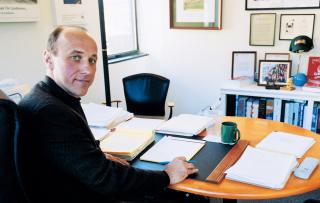
In Andrews’s office, on a fifth floor off Dupont Circle, the walls do talk. Andrews swivels around a U-shaped burnished maple desk, switching his attention from the constantly ringing phone to the bleeping laptop to the various staffers who pop in periodically to check the wording of press releases. Windows line two walls, looking out over rooftops and the top of an elm tree.
All the other wall space is packed with the artifacts of an activist—a letter from the late Senator Margaret Chase Smith of Maine, an original “Doonesbury” on censorship signed by Garry Trudeau, panoramic photos of the view from his cabin on Berry Pond in central Maine, a 1991 poster of the Maine Organic Farming and Growers Association’s Common Ground Fair, photos of Andrews posing with the Dalai Lama, with Desmond Tutu, and demonstrating with Jessica Lange and Ethan Hawke.
But those are not the photos that he wants to talk about. Andrews’s blue eyes light up as he stops before a small framed photo showing a stocky, middle-aged Maine farmer holding a sign with a huge “No!” on it. In the mid-1980s the federal Department of Energy proposed storing half of the nation’s low-level nuclear waste under Sebago Lake in southern rural Maine.
The local citizenry demanded a hearing and turned for help to Andrews, then a state senator. Andrews was concerned about booking too large a space. Crowding folks a little, he reasoned, was far better than an empty-looking room. But the locals insisted on the high school gym. They wanted a simple message. Andrews suggested, “How about ‘No!’?” The day before the hearing, the group silkscreened 3,000 “No!” signs.
After the gym filled on the day of the hearing, the fire marshal sent people to the auditorium; when that filled, to the cafeteria. When the DOE reps showed, the Mainers spontaneously stood in unison, held up their “No!” signs, and broke into “America the Beautiful.” It was over. There’s no nuclear waste under Sebago Lake.
On the facing wall a photo of Andrews with Archbishop Desmond Tutu serves as another reminder of the power that people without official portfolio can wield.
At the 2001 Nobel Peace Prize ceremonies, Andrews and Tutu staged a call for democracy and human rights in Burma. Aung San Suu Kyi had been elected the country’s leader in 1990 but was at that time under house arrest and has never been allowed to govern. In 1991 she won the Nobel Peace Prize but did not travel to Oslo to accept it.
At the tenth anniversary of her prize, twenty-seven Nobel laureates took the stage in Oslo with the Norwegian prime minister. Connected by satellite and Web streaming, supporters in thirty-seven sites around the world joined them, including 500 people at 8:30 a.m. at the Washington Chamber of Commerce offices and 1,500 at 8:30 p.m. in Bangkok.
Within twenty-four hours of the event, the Burmese junta, which has been cited for horrific human-rights violations in eleven United Nations General Assembly resolutions and by the Human Rights Commission and the International Labor Organization, and has never responded to any of them, issued a response and allowed the National League for Democracy party to reopen its Rangoon offices. In May 2002 it released Suu Kyi from house arrest.
“And this came about because of international community—the power of citizens, not government officials,” Andrews says. Although Suu Kyi has still never been allowed to take her elective office, she was freed for a year; since last May, the junta has again been holding her under house arrest in Rangoon.
Ralph Nader once called Andrews “the most principled politician I have ever met.” Columnist Jack Anderson called him “the most courageous member of Congress.” Congressional Quarterly rated him the most progressive congressperson of 1994. The UUA awarded him the Wilton Peace Prize in 1995, in part for voting his convictions.
As a congressman from a small state, Andrews openly relished airing his controversial opinions—and so did the press. He was the first congressional representative from Maine, known for its deep-woods hunting, to cross the National Rifle Association, by supporting the Brady Bill. He actively supported closing thirty-three obsolete military bases, including Loring Air Force Base in Limestone, Maine, even though his state’s economy has historically relied on navy-shipbuilding and other military contracts.
“I think I was the least lobbied politician in history,” Andrews says. “Everyone always knew where I was coming from. I liked to really challenge people, not just throw back what the pollsters told you.” He laughs. “In that sense, I was such a bad politician.”
Andrews lost his 1994 U.S. Senate bid to Maine’s one other House representative, Olympia Snowe, in a race that some commentators said he could have won with more calculated politicking and less straight shooting.
One Friday afternoon, a letter from Snowe arrived at his office. She wanted all four Maine congresspeople to introduce legislation to abolish the Base Closure Commission and to keep all thirty-three bases open. Andrews sent it back to Snowe—unsigned—and headed for Maine in his mobile-office van.
Somewhere along I-95 , the phone rang. An Associated Press reporter was on the line: “Why isn’t your name on the letter? Did you leave Washington before you saw it?”
“No.”
“Well, are you thinking it over?”
“No.”
“Did you intend not to sign it?”
“Yes.”
Silence.
The next day, the news was on front pages all over the state. A cartoon showed a plane with three of its four open-cockpit seats filled and Andrews in a parachute. People in Maine were furious. At one speech, several people stood and turned their back on Andrews. “I stopped and said, ‘What is the fear here? If it’s jobs and the economy, then let’s make that the issue.’ I was working on a defense reinvestment program—to build things we actually needed, like a first-class rail system. I should have had a clear strategy to get my message out. I made a tactical mistake, but only tactical. I don’t regret it for a second. I’d do it again.”
Fury over being politically manipulated cost Andrews in another crucial way the year before the Senate race. Just before the vote on the North American Free Trade Agreement, President Bill Clinton called Andrews, who was president of the House freshman class: “Before you make a final commitment, would you sit and talk with me and the vice president and the secretary of labor?”
Andrews replied, “Absolutely.”
He immediately picked up the phone and told his union supporters that he was inclined to vote against NAFTA, but he wasn’t taking a final position till his meeting with the president. The next day, two activists from major unions in Maine were quoted in the media saying that Andrews would be voting against NAFTA, because if he didn’t, he’d lose substantial union campaign contributions.
“I really thought it through,” Andrews says. “I told the president, ‘If you make worker and environmental protection part of NAFTA, you’ve got my vote.’ But in the end, I concluded that, notwithstanding the president’s arguments, I was against.”
Andrews called a news conference in Portland, Maine, to announce his decision. Reporters from the national media and from Canada and Europe packed the hall. As he was speaking, he noticed in the back the two union people who had spoken to the press.
“This is how bad a politician I am,” Andrews recalls. “I stopped and pointed at them and said, ‘Let me tell you something. You may like how I’m going to vote on this, but you have made this so ugly. You have disparaged my character and people’s view of government. I don’t want your money. I will not accept a penny of labor money in this election. I will not be bought!’”
Afterward, one of his staffers took him aside and asked, “So what does a $250,000 high feel like?”
Labor donations had been Andrews’s single largest source of funding, so he had very little going into the Senate race. High-ranking Democratic Party officials called begging him to reconsider. He wouldn’t.
“The biggest problem is money,” he says of electoral politics. “We have to limit the power of money. I was in office for twelve years, I never compromised on principle, I was able to sleep at night, and I lost only one election in six. So I’m not discouraged. It can be done.”
Andrews has no plans to run for office again but allows, “Never say never. To me, being in politics is just one manifestation of doing this work. It’s like changing your clothes. It doesn’t matter what your job is—just moving down the path to help the planet along.”
Of all the places he’s traveled on the planet to do that work, Andrews’s heart still resides in Maine. He longs for his sanctuary, his electricity-free cabin at Berry Pond, especially at twilight. Yet he spends most of his time in D.C. Two-thirds of his work the past year has been on Win Without War. His wife, Debra, directs the Center for Global Opportunities, hosting international students and professionals at Southern Maine Community College in South Portland, where they have another home. “It can be schizophrenic. It’s a challenge, keeping a center,” he admits.
Engagement is his antidote—with people as well as with the world. “He’s the warmest person you can ever imagine,” says the Rev. Patricia Tummino, minister of the First Unitarian Universalist Society of Middleboro, Massachusetts, and a close friend for many decades. “I can remember sitting with him on the floor at a party and talking so intensely I’d forget the rest of the party going on around us. Then at his wedding in Maine, I watched him greeting people in this huge reception line, and he seemed to have the same intimacy with every person.” The friends lost touch except holiday cards after Andrews was elected and Tummino started divinity school. Once when in Washington, she and another longtime Massachusetts friend surprised him at his office in Congress. “I had been afraid of what he was doing,” Tummino admits. “He was big league now. But when he walked in and saw us, you could see his immediate pleasure. In fact, he needed his good friends—he was clear about that. And he’s been the one who keeps our relationship vibrant when we’re all too busy.”
Hope and faith are also a big part of what keep him going—and keep his end of the bargain he made as a teenager. Andrews’s understanding of God has changed a lot since then. But he’s still serious about the deal he made and how it has shaped his life. “Cynicism and hopelessness are the challenges for our side,” Andrews says. “We’ve got to stay engaged as long as the odds may be. I am hopeful.”