Advertisement
Hour after hour, Atlanta citizens came forth to speak before their elected City Council representatives—many for the first time in their lives. People of all ages, races, and backgrounds were nearly unanimous in their desire to stop the building of the proposed new police training facility informally known as “Cop City” (an observer recorded 98 percent of testimony calling to halt the project).
The proposed massive training facility unleashed a torrent of objections over further police militarization, wasting taxpayers’ funds, ignoring citizen input, and clearcutting scarce urban forest, which would deprive a neighborhood of Black and lower-income residents of needed respite and cooling properties.
Over fourteen hours at that June meeting, hundreds of people urged the council members to stop their plans to sacrifice public land and funds to build the complex. Despite the overwhelming opposition, the council voted to enable Cop City’s construction.
Faced with their city government’s disregard for democratic input, Atlantans have not given in but instead are escalating the struggle to stop Cop City on multiple fronts, including a planned citizen initiative, legal challenges, and direct action.
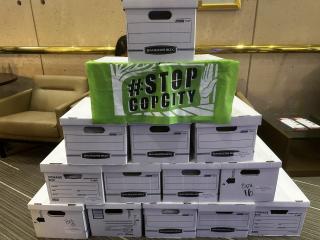
Unitarian Universalists—including Side With Love, the Unitarian Universalist Service Committee, and local congregations—have engaged on each front, partnering with Vote to Stop Cop City and the Stop Cop City faith coalition. Those actions have included Side With Love staff going to Atlanta and rallying UUs to canvas the city, collecting signatures to place a referendum on the ballot that would let Atlantans decide the fate of the Cop City plan.
On September 7, faced with police and the City Council escalating their attacks on the democratic process, Rev. Dave Dunn (UU Metro Atlanta North) and Rev. Jeff Jones (minister emeritus with the Emerson, Georgia, UU Congregation) joined three other people to put their bodies in the way of construction and make a strong moral statement, employing non-violent civil disobedience to physically stop the construction process until they were arrested.
Protesters posted a “stop work” notice on the fencing surrounding the Cop City site, which said they were shutting down the project for violations, including “destruction of a forest, destruction of the public trust, polluting Intrenchment Creek, violating the will of the community, undermining the democratic process.” All five people were subsequently released shortly after their arrests.
What provoked citizens to put their bodies on the line and go through arrest and prosecution? From city officials to the Georgia Attorney General, government officials have shown disregard for their constituents, not only by acting against their will but through voter suppression tactics, concocting bogus felony charges against activists and killing a young activist, Manuel “Tortuguita” Terán, with a barrage of fifty-seven gunshots as they sat unarmed in the forest.
The militarized response to protesters working to prevent the clearcutting of forest chillingly demonstrates the mindset of violence and conflict that the facility would likely worsen.
The plan by Atlanta city officials to discard petitioners’ signatures that vary from their driver’s license signature is a voter suppression tactic widely condemned by Georgia voting rights organizations and elected officials (including the state GOP). In 2018, a U.S. district judge ruled signature matching is a “severe burden” for voters, and the Stop Cop City Coalition issued a legal memo detailing the case against exhaustive signature matching (rather than statistical sampling).
The civil disobedience arrests occurred just days after sixty-one Stop Cop City environmental defenders and organizers were indicted on Racketeer Influenced and Corrupt Organizations (RICO) charges pursued by Republican State Attorney Chris Carr. RICO laws are intended to prosecute organized crime but are being weaponized by Georgia law enforcement agents in this case to suppress democracy. The ACLU, theNational Lawyers Guild, and theSouthern Center for Human Rights all condemned the RICO prosecution, which alleges such heinous crimes as “mutual aid, collectivism, and social solidarity.” The bad-faith prosecution exemplifies why the Stop Cop City campaign is attracting national attention and energy—the organizers are working to defeat systemic oppression and attacks on the democratic process, not just one ill-conceived project.
Nicole Pressley, Side With Love’s Field and Programs director, helped train and deploy signature gatherers in Atlanta. She says, “The campaign is about resisting the systems designed to make us all less free.” The brazen attempt to stifle citizen engagement by weaponizing the legal system is especially dangerous. It recalls the COINTELPRO program of the FBI, which first sought to undermine communists in the United States, then expanded to harass and sabotage members of many social change organizations, and—in the case of the Black Panthers—kill movement leaders.
“As Unitarian Universalists, we not only condemn these actions, but we support people and communities through mutual aid,” said Pressley. “We build power for justice through collectivism and deepen our relationships and capacity for liberation through solidarity. These practices are the expression of the core principles we uphold as a covenantal faith. The care for our communities is central to a democracy that is truly for the people and by the people. It is what we do when we love one another, in public and in community.”
With public officials so determined to ram through Cop City over any and all citizen opposition, it’s hard not to wonder whether they will find a way to negate or subvert any public opposition, even a successful ballot initiative. I asked Rev. Jonathan Rogers, minister for Social Justice with Abundant LUUv Unitarian Universalist church in Atlanta, about whether he feared people feeling defeated if Cop City moves forward. He told me more than sixty UUs in northern Georgia have engaged in the campaign thus far, including phone banking, canvassing, and more.
“Whether we win or lose, that [organizing work] is powerful and builds capacity. It deepens relationships,” Rogers explained. “This is an opportunity to demonstrate that when folks are organized and unified in solidarity, that we have the power to resist the corporations and calcified government institutions—that we don’t have to get steamrolled. If we can win here then we can win anywhere.”
Rogers sees this work as a continuation of work he did with UU the Vote in 2020 to expand democracy: “This didn’t start with Cop City, and it doesn’t end there.” As for the danger of rallying folks to engage in the campaign and then suffering defeat, Rogers expressed his conviction that we must fight for justice even if the odds are long: “If we don’t imagine it, then we sell ourselves short.”