
Advertisement
They answered the call by the hundreds, driving and flying from around the country to bear witness in the place where a federal officer shot an unarmed woman to death. They joined thousands of their fellow clergy, bundled in thick coats for protection against the bitter subzero cold.
And together, Unitarian Universalists and other people of faith marched and sang and prayed in Minneapolis on Friday, sending a powerful, unified message: that love is greater than ICE.
Hundreds of UU clergy and laypeople from across the nation joined The Day of Truth and Freedom, a nonviolent moral action and reflection calling for the end of ICE operations in Minnesota. Organized by labor unions, community leaders, and faith groups, The Day of Truth and Freedom included a rally and march in downtown Minneapolis. It urged Minnesotans statewide to stay home from work, school, and shopping in favor of “community, conscience, and collective action,” according to ICE Out of Minnesota.
At about 2:30 p.m., a huge, tightly packed, and boisterous crowd started the march at the Commons, a public square downtown, and moved slowly through the city holding signs and chanting, “ICE out!” and “No justice, no peace, no ICE in our streets.” People in the sky bridges between buildings also held signs and cheered the marchers below. A person handed out warm empanadas to participants. With temperatures reaching –8 degrees, frost formed on eyebrows and beards.
At the Minneapolis-St. Paul International Airport that day, about 100 clergy, including about a dozen UUs, were arrested while protesting deportation flights, said Rev. Jen Crow, senior minister at First Universalist Church of Minneapolis, who was among the clergy arrested.
At a pre-march gathering Friday morning at a church near downtown, clergy, some wearing clerical collars, gathered in a hall. The bustling, noisy space was filled with bright stoles: one emblazoned with a pride flag, some with crosses, one with the Disciples of Christ chalice, and about a dozen yellow Side With Love stoles. At noon, the temperature was –12, and most people were decked out in heavy-duty, cold-weather clothing: balaclavas, snow boots, even ski goggles on a few. Despite the threat of extreme cold—including rumors of the potential for trees to explode—the crowd seemed undeterred.
Volunteers and church members passed out granola bars, coffee, and warmers for hands and feet. “Even if you don’t think you need these, you do!” shouted a local. Volunteers also provided a hearty soup lunch.
The gathering opened with the group singing “Our Power,” by Rena Branson, repeating this line over and over: “We will not underestimate our power any longer.” In a kind of mini-march before the big march downtown, about 100 people walked around the block to show solidarity with people of the neighborhood. One marcher held a sign with a butterfly on it and the words “El Amor no conoce fronteras”—Love knows no borders.

Black Lives of Unitarian Universalism Executive Director Lena Gardner hugs Rabbi Barat Ellman from New York, who answered the call to come to Minneapolis, during a community event at a church in Minneapolis, Minnesota.
“I want people to understand the truth of the hardships we’re facing, and I want them to know the truth of the resilience we are building,” Lena Gardner, executive director of BLUU (Black Lives of Unitarian Universalism), who lives in Minneapolis, told UU World. “People are coming together in new ways to help support our immigrant community and each other. Making meals, paying people’s rents because they can’t go to work, giving children rides to school, giving people rides to doctors’ offices. These are all things we were not doing before ICE invaded our city.”
Gardner added, “I want people to hear and understand the beauty of this” community building and mutual aid. More importantly, she said, “I would encourage people in their own communities to start doing these things now, forging new relationships with immigrant-led organizations and your neighbors… Start building these connections now because when ICE, or another government entity, comes into your city, you will be more ready. You will be more connected, and more connected people are safer. More connected people are harder to repress.”
In the wake of an ICE agent fatally shooting Minneapolis resident Renée Good on January 7, and in response to targeted violence against immigrant communities throughout the country, MARCH (Multifaith Antiracism, Change & Healing), a pro-queer group of multiracial clergy and faith leaders, put out a call for multifaith clergy to gather in Minneapolis on Thursday and Friday, January 22 and 23.
“During the Civil Rights Movement, especially after Bloody Sunday, Reverend Martin Luther King, Jr., put out a call for clergy to come to Selma and bear witness … You [UUs], you were there … you have a history of being there. Keep it up, keep showing up, keep doing it,” Rev. Dr. DeWayne Davis, a member of MARCH who teaches at United Theological Seminary of the Twin Cities, told UU World. “Be a witness to this promise of wholeness and freedom for all humanity. It will make a difference.”
On Thursday, hundreds of clergy and faith leaders of many faith groups gathered for relationship-building, spiritual grounding, and orientation to what is happening on the ground in Minneapolis.
“I am keenly aware that what is happening here is happening across the country…so I feel it is important for us to have a national witness,” Rev. Mariann Budde, an Episcopal prelate who is Bishop of Washington, D.C., told UU World. Budde gained national attention in January 2025 when she addressed President Trump directly during a prayer service for the inauguration, calling on him to have mercy on transgender children and immigrant families.
UUs “are here in large numbers relative to your size, and your faith tradition has such a history of commitment to social justice, and that is well represented here,” Budde told UU World. “I think [UUs] would feel a combination of both heartbreak at what’s happening [and] an incredible sense of honor and pride to be a part of people of faith and goodwill, who are doing lots of things, large and small, to keep the fabric of society woven together.”
Rev. Ben Atherton-Zeman, minister at the UU Church of St. Petersburg, Florida, is one who answered the call to Minneapolis. “I am here for reasons of morality and ethics. ICE, I feel, has sacrificed any moral authority in the way they have done their job so poorly, so illegally, so violently,” he told UU World. “I would say [to all UUs] to answer the call.”
Erol Delos Santos, a Union Theological Seminary graduate preparing for UU ministry, is director of congregational life at UU Society of Oneonta, New York. “Oneonta is a pretty rural congregation, and I think there’s a misconception that the presence of ICE doesn’t really reach rural congregations in a way that it reaches major cities,” Santos said. “So I really wanted to take a look at the impact myself and bring those facts and that public witness back to my congregation to let them know that this is a military occupation … And when this call came out, it seemed like a good call to follow. I feel really supported and hopeful that so many different denominations and faith traditions are coming together with a similar purpose.”
On Thursday evening, Rev. Dr. Sofía Betancourt, president of the Unitarian Universalist Association (UUA), gave the after-dinner prayer at a local church that hosted about 200 people for dinner. “Let us be reminded of the greater calling, the greater possibility, the greatest promise of our living tradition,” Betancourt said, adding, “We are moving and joining movements through the strength of all those who worked and fought and sacrificed and struggled for the freedom, the wholeness, the well-being of all, for that love that abides, which resides in us, as long as we are on this planet.”

Rev. Dr. Sofía Betancourt, president of the Unitarian Universalist Association, addressing an audience in Minneapolis, Minnesota.
At a press conference earlier Thursday, ten faith leaders stood as a group, including Betancourt and Gardner. Those who spoke included Budde, who said, “A dangerous line has been crossed. Peaceful protestors are being killed. This moment calls us all to moral clarity and civic responsibility.” Jamie Beran, CEO of Bend the Arc, a Jewish social justice group, also addressed the media, saying, “When people like me from across this nation saw our neighbors in need, and heard the call from our friends here in Minnesota, we came from all over the nation to stand together … There is no holier call to action than the call to action for each other.”
Valerie Kaur, a Sikh activist and founder of the Revolutionary Love Project, also spoke at the press conference, saying, “Revolutionary love is the choice to leave no one outside of our circle of care, to risk ourselves for one another, to show up with whistles when they have guns. And that love is a force that this administration cannot defeat.”
In putting out the call to clergy, MARCH described Minneapolis as “at the center of a crisis that has been long in the making,” and a “crisis of our Constitution, federal overreach, militarized enforcement, and the erosion of civil liberties.” It added, “We therefore call on clergy and faith leaders of all faiths, representative of every part of the country, to join us for a day of witness and resistance…”

Unitarian Universalist ministers and UUA leadership in Minneapolis, Minnesota.
MARCH said the current crisis in the Twin Cities has “echoes of Selma [Alabama],” a reference to the Selma March of 1965, when Rev. Dr. Martin Luther King, Jr., put out a nationwide call to clergy to travel there to support the struggle for civil rights. “It is in that same spirit—and with that same clarity—that we issue this call now,” MARCH added.
Rev. Terri Burnor, executive director of the Minnesota Unitarian Universalist Social Justice Alliance (MUUSJA) and a lifelong Minnesotan, is on the MARCH core planning team. “People do not understand what it is like here, what it’s like to be in an occupied territory,” Burnor said Thursday. “They don’t understand what it’s like to have helicopters flying over your head, to have whistles blowing, to have people showing up to patrol their daycare centers and their schools.”
Rev. Laura Smidzik, assistant minister of First Universalist Church of Minneapolis, helped distribute warm clothing to attendees on Thursday. “We have 3,000 ICE agents on the ground here. Restaurants are closing because they can’t keep their staff there. [Agents] are around schools and hospitals,” she said. MARCH organized the call to clergy in six days, Smidzik said, adding, “People are desperate to help and want to be part of this larger community that we’re creating here. People are standing up.”
On January 7, 2026, Good, a U.S. citizen and 37-year-old mother of three, was shot dead in Minneapolis by ICE agent Jonathan Ross, sparking immediate protests in that city and around the country. President Donald Trump and others in his administration claimed the agent acted in self-defense, while many others insist the shooting was entirely unjustified and a violation of law enforcement procedure. In one of a number of targeted immigration enforcement efforts, Trump has sent over 3,000 federal agents to Minnesota in “Operation Metro Surge.” Good’s killing has intensified national calls for the abolition of ICE, which has been involved in numerous violent confrontations and shootings during Trump’s second term.
“The ICE ‘surge’ that cost the life of Renée Nicole Good is violating the Constitutional and human rights of Americans and our neighbors,” according to ICE Out. The Day of Truth and Freedom is calling for ICE to leave Minnesota immediately, for the officer who killed Good to be held legally accountable, for the end to any more federal funding for ICE, for ICE to be investigated for Constitutional and human rights violations, and for the state of Minnesota as well as national corporations—including Target, Delta, Home Depot, Hilton, and Enterprise—to stop economic relations with, and other supports for, ICE.
Minutes after Good was killed on January 7, a number of UU ministers and laypeople rushed to the scene, including Rev. Ashley Horan, the UUA’s vice president for Programs and Ministries. Horan, who resides near the site of the shooting, livestreamed from the scene. Her footage captures ICE agents firing chemical irritants at protesters, according to a report from the Religion News Service. In a video she posted on Facebook, Horan said federal agents were attempting to “fracture and terrorize our communities,” which goes against UU values.

The Rev. Ashley Horan, Unitarian Universalism Association Vice President for Programs and Ministries, speaks Thursday at a gathering in Minneapolis, Minnesota.
Crow, senior minister of First Universalist Church of Minneapolis, described ICE’s presence on the scene as “an overwhelming show of force,” saying that over fifty agents were present after Good’s killing, many heavily armed. “It was a war zone,” she said.
“It’s felt hard to tell people outside of Minneapolis what is happening here. And this could happen anywhere,” Horan told UU World. “Renée Good was killed one block from my house, and I had to explain to my child what had happened, and it was devastating to me. But when we drive through my neighborhood with my children on the way to school, I can say, ‘Look, those are the people who are patrolling to keep our neighbors safe. Look at the parents standing outside the school across the street who are making sure that classmates can get in and go to school … I don’t know anybody in Minneapolis who isn’t doing something.”
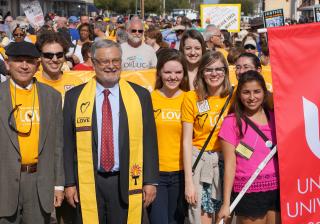
More than 500 Unitarian Universalists join 50th anniversary march in Selma, Alabama.
In a January 14 interview with the Religious News Service, Horan, who since Good’s killing has patrolled her Minneapolis neighborhood looking for the presence of ICE, pointed to the history of UUs in the famous civil rights march in Selma. During that action, Rev. James Reeb, a UU minister from Massachusetts, was killed by white supremacists, and Viola Liuzzo, a UU and civil rights activist from Michigan, was murdered by Ku Klux Klan members as she was driving activists who were participating in the march. They were responding to a call to clergy from the Rev. Dr. Martin Luther King, Jr., to join the march.
“Those folks are very front of mind right now, particularly Viola Liuzzo and the ways in which she feels so similar to Renée Good,” Horan told RNS. “She was a mom, she was somebody who was drawn to just show up in ways that she could and ended up losing her life because of her convictions.”
In 2017, about sixty clergy, including UUA President Susan Frederick-Gray, marched in Charlottesville, Virginia, in an interfaith, nonviolent protest against a white supremacist rally, during a day that turned violent and left three people dead and dozens injured. None of the clergy were injured, though white supremacists charged at them before anti-fascists, or “antifa,” stepped in and violence erupted. A number of the clergy credited antifa for protecting their lives.