
Advertisement
There are days when hope feels impossible. When the onslaught of violence and chaos pull us farther from the better world we imagine, one that centers love and provides justice to all.
Unitarian Universalism offers resources that can help with grounding to sustain UUs and non-UUs alike who feel overwhelmed and in need of a reset.
UU World curated prayers, reflections, music, poems, art, and essays, shared below, that you can turn to in these turbulent times.
Chalice Lighting: The Sacred Power of Justice
We light this flame
To ignite the sacred power of justice.
We light this flame
So that it may be a beacon of hope
In moments of uncertainty, fear, anxiety, and the unknown.
We light this flame, and are emboldened by its blaze,
Knowing our strength as a prophetic and powerful people
Is rooted in the diverse ways we answer the call to love.
— Rev. Jami Yandle, UUA Transgender Support specialist
Read the chalice lighting on WorshipWeb.
Chalice Lighting: A Spark of Hope
If ever there were a time for a candle in the darkness,
this would be it.
Using a spark of hope,
kindle the flame of love,
ignite the light of peace,
and feed the flame of justice.
— Dr. Melanie Davis, UUA Our Whole Lives program manager
Read the chalice lighting on WorshipWeb.
Our New Day Begun
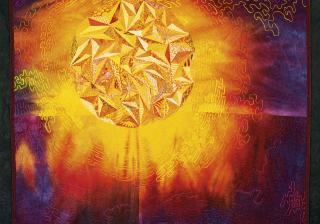
Artist Gwendolyn A. Magee’s vibrant art quilt inspired by ‘Lift Every Voice and Sing.’
On Feeling Grief
“Like living cells in a larger body, it is natural that we feel the trauma of our world. So don’t be afraid of the anguish you feel, or the anger or fear, because these responses arise from the depth of your caring and the truth of your interconnectedness with all beings.”
— Joanna Macy (1929–2025), environmental activist and author
“A Prayer for Hard Times”
Spirit of Life and Love,
Be with us in this time, as people suffer, as parents grieve, as violence rages. Be with us who feel the pain of loss, who feel anger at injustice.
Be with the oppressed and change the heart of the oppressor, for we know that both are joined in their humanity, no matter how often we forget it.
Help us remember the hope we had, the hope we have, and the hope we will have; help us remember joy in the midst of sadness, success in the midst of challenge, and good things in the midst of bad.
Help us to be better people, to work for better things, and to create a better world.
Amen.
— Rev. Christian Schmidt
Find the prayer on WorshipWeb.
A Hopeful Song About Better Days
“Tomorrow” composed by Kate and Justin Miner and performed by the UUA General Assembly 2020 virtual choir.
Solace in Unitarian Universalism
In a 2014 UU World essay, Air Nonken Rhodes examines how to navigate the limits of human experience.
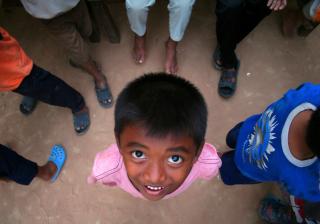
We all navigate through circumstances at the limits of human experience.
Everyone’s personal moral compass needs some assistance. Religious community, our whole global community of UUs, can help us navigate the world when we feel lost: not because others will have the answers for us, but because together we can each help remember and believe in what we already know, sharing support when we struggle to resist hate, despair, and, most insidious, apathy.
The Rev. Tom Schade correctly argues that religious community is not enough, and that we need to actively live our values in the world. But we also need to preserve, improve, and extend the aspect of Unitarian Universalism that provides a safe haven and an engaged moral community for those who continue to be embattled in places of real challenge (i.e., most of the world). I want to see us build a Unitarian Universalism whose community and theology are not only actively supportive and relevant for people like me, but relevant and supportive for my former students.
Unitarian Universalism is a beautiful place, and we have so much solace to offer. We also have a great history of reaching out to isolated religious liberals, and of grappling with really tough issues. I truly believe we have the moral tools and spiritual community we need to succeed in this work; we just need to learn how to use them powerfully. We need to teach ourselves and our young people how to translate our values on the larger, fraught global stage. The next time I step into a dangerous role, I want Unitarian Universalism to really be at my back, filling me up, and pointing the way.
Pegasus Rising

A Song About Leading Together with Love
In 2020, during the COVID-19 pandemic, Unitarian Universalists joined the UU the Vote “How We Thrive” virtual choir to sing the MaMuse song, “We Shall Be Known.”
Working in Community to Build a Better World for All
As part of 30 Days of Love, “Side With Love’s Rev. Brandan Robertson and Nicole Pressley discuss how movements remain responsive to local conditions while coordinating collective action at scale—especially amid political instability, democratic erosion, and overlapping crises,” according to the group’s YouTube channel.
“I think we have to protect our energy. [Worrying] is exhausting. Looking at yourself as an individual and then looking at the evil in this world is daunting. I would say, one, ask yourself the question, are you so busy worrying that you’re actually not taking action, right? [Are the] fear, and the exhaustion, and the heartbreak actually keeping you from doing? And one thing I’ve said on our team is humbling yourself to realize that your individual actions are insufficient. They are. Individually, looked at individually, insufficient. You are not going to topple authoritarianism. Now, you, and your friends, and your family members, and your coworkers … you can do something. And you doing something can inspire other people to do something, and so on. I would ask myself, is this stopping me from doing what I can do?”
— Nicole Pressley, Organizing Strategy Team director
A Trembling Courage is Still Courage
This is an excerpt from “Courage Requires Vulnerability” a 2017 reflection by Rev. Marisol Caballero that is available on WorshipWeb.
Courage does not ask us to stop trembling; it asks us to find ways to incorporate our trembles into our dance.
Courage, the faithful companion of hope, is sticking around when “we” and “us” are spoken in contexts that clearly don’t mean “me.”
Courage is claiming this faith as home when nearly everything around me says I am out of place, yet everything inside me says I am home.
Courage is the generations and generations of ancestors who taught us to actively pursue joy, laughter, and celebration alongside outrage, grief, and fatigue.
The goddess Tonanztin, madre de los Méxicos, bringer of corn, nuestra morenita, teaches that we can make for ourselves a place of comfort and leave room for wonder, even when our home has been invaded and has become nearly unrecognizable. Courage is being firm in saying, “I know exactly where home is and what it looks like. I will figure out any way to get there, with the help of good friends. We will dance the whole way there, through the terrifying unknown. I will brave the rough waters knowing that my boat may be smalI but it is strong. I will leave a trail of beauty in my wake, so that other courageous seekers who follow will not be lonely on their journeys.”
Read the full reflection on WorshipWeb.
Together We Grow
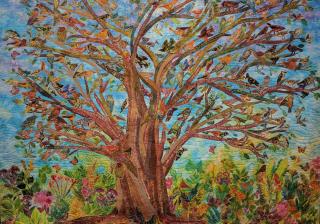
Quilt made by members of the All Peoples UU congregation in Louisville, Kentucky.
Poem: How to Survive the Apocalypse

When the world ends, we must not / add destruction to destruction
Excerpted with permission from Breaking and Blessing: Meditations by Rev. Sean Parker Dennison (Skinner House, 2020).
First, learn to listen.
Not only for enemies around
corners in hidden places,
but for the faint footsteps
of hope and the whisper of resistance.
Hone your skills, aim your
heart toward kindness and
stockpile second chances.
Under the weight of destruction,
we will need the strong shelter
of forgiveness and the deeper wells
that give the sweet water of welcome:
“We have a place for you.”
The Restorative Weariness of Grief
In this 2015 excerpt from his book “Nothing Gold Can Stay: The Colors of Grief,” Rev. Mark L. Belletini recounts life during the early days of the HIV/AIDS epidemic and the emotional aftermath.
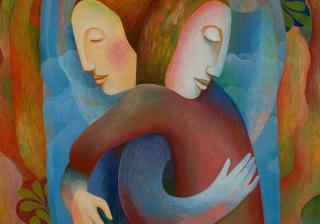
Grief has often worn me out, while restoring me to myself at the same time.
I said to Richard, “I feel like I have been weary to the bone for almost two decades. Memorials almost every weekend. Not a day went by when I didn’t open the newspaper and see the face of someone I used to know—and often cared about—in the obituaries. I just shut down so many parts of my soul. I feel like I am recovering and opening my soul so that it once again can move through the world with openness and gratitude.”
Our reflective conversation describes one aspect of the weariness associated with grief. Grief can arrive on our shores not as a wave but as a series of tsunamis.
A woman in the congregation I serve recently reminded me of something else I have experienced with grief: weariness in the form of sheer bodily exhaustion. Sobbing takes it out of you physically. It works the muscles and alters the breath. It tires the bones. The whole effort to focus on the ordinary needs of life—food, laundry, and so forth—in the midst of grief can feel as though you had just spent three hours running a course or lifting weights in the gym. In the weeks after Stephen died I remember how frequently I would fall asleep simply sitting up in a chair. I deliberately made taking naps as much a part of my day as eating supper or brushing my teeth, even if I had managed to sleep deeply the night before.
Grief has often worn me out, while restoring me to myself at the same time. But the one does not seem to come without the other.
Nurturing Beauty

An excerpt with permission from the sermon “Nurturing Beauty,” by Rev. Otto O’Connor.
The sermon was delivered at First Parish in Malden, Massachusetts, on May 22, 2022.
It’s the terrible things that put the beauty in sharp relief.
My message to you is to allow yourself to see that beauty,
to find it,
to create it amidst the reality of our world,
to treasure its fleetingness and let it go.
It’s a way to survive;
it’s an act of rebellion, to see this true beauty around us.
Watch the full sermon on YouTube.
Your Peace

Lamar Bailey’s latest artistic creation challenges UUs to reflect and search for inner peace.
A Song About Perseverance and Faith
A traditional spiritual “There Is More Love Somewhere,” arranged by Adam and Matt Prodd and featuring the First Unitarian Brooklyn Choir. It was produced and edited by Adam Podd and Scott Cook for online worship at First Unitarian Congregational Society in Brooklyn February 14, 2021.
Extinguishing the Chalice: Where Holiness Is Hard to See
As we extinguish this flame,
may we carry its smoke with us—
into the streets,
into the places where holiness is hard to see
but always waiting to be noticed.
Let us go
with eyes open for wonder in the worn-out,
with reverence for each passerby,
and with the knowing that the sacred
does not hide from the world—
it lives in it.
Go now—
not to escape the brokenness,
but to journey beside it,
and sometimes, to bless it.
—Craig Rowland