
Advertisement
For the first time—for a few days, at least—General Assembly was all business.
In an experimental approach to doing the work of the Unitarian Universalist Association’s annual General Assembly (GA), this year the business portion was held June 14–16 entirely online and separately from the rest of GA programming. The 2026 “Everywhere GA” splits activities into two halves, with business occurring first and then worship, celebration, and more happening in person at a “studio site” in Louisville, Kentucky, at seven satellite locations, and online.
The GA approach was designed to offer UUs flexibility, reduce travel and environmental impacts, and streamline production, while also allowing live engagement for participants who value being in community face to face.
Some of the liveliest discussion during this year’s business sessions happened on the final afternoon, as delegates debated Actions of Immediate Witness (AIWs) on environmental protections and activism outside of ICE detention centers, and Responsive Resolutions related to support for UU youth and emerging adults, immigrant justice, and engagement with the Southwest Asia and North Africa region.
AIWs are statements about a significant action, event, or development in the world that necessitates immediate engagement and action among UU member congregations and groups. Responsive Resolutions are brief, advisory statements that express the sentiment of the delegates in response to a substantive portion of a report during GA.
An AIW calling on Unitarian Universalists to challenge the recent rescission of federal rules protecting millions of acres of public lands in order to allow the fossil fuel, mining, and other industries to operate there passed overwhelming with 98.5 percent of the vote.
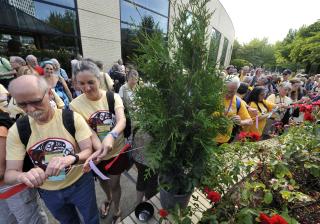
General Assembly public witness event calls UUs to commit to climate justice.
The AIW, “Defend Against the Assault on Environmental Protections: Public Lands Rules and the Endangerment Finding,” condemned “an assault on our environment” in the form of many new executive orders, laws, and rules changes. This AIW asks UUs to work to restore the rescinded rules and regulations by lobbying state and federal legislators, partnering with environmental and other groups, and more. It was cosponsored by UU Ministry for Earth, UU Animal Ministry, many UU state action networks, and others.
The AIW was proposed by Deborah J. Cruz, president of JUUstice Washington, a UU state action network, at the request of Se’Si’Le, which was founded by Jay Julius, a member of the Lummi Nation. Julius and other First Nation leaders were joined by 2,400 UUs in the public witness event at GA 2015, in Portland, Oregon, in fighting to stop the largest coal terminal in North America from being built on their sacred waters and lands. Se’Si’Le is an indigenous-led nonprofit working to protect the earth and Indigenous rights.
The federal government owns and manages roughly 650 million acres of land—about 30 percent of the U.S. land mass—including national parks, wildlife refuges, recreation areas, and seashores, according to Cruz, who said, “This is not just about tribal lands, it is about all of us. None of us will have access to those things we held precious before.”
Cruz said she is working on a toolkit for UUs, including templates for writing letters to the editor, letters to congresspeople and other legislators, and other resources “to make it easier for people to take action,” she says.

Around 300 detainees began the hunger strike on May 22.
A second AIW, “All Eyes on Delaney Hall: Vigils, songs, and support outside ICE detention centers across America, in solidarity with those on hunger strike, their families, and their supporters,” prompted passionate debate and was ultimately not adopted, with 85.5 percent of delegates voting against it.
More than 300 people detained at the Delaney Hall detention center in Newark, New Jersey, launched a hunger and labor strike on May 22 that has spread so that nearly 1,000 people held captive by ICE are on hunger strike in at least seven facilities, the AIW stated. It asked UUs to meet outside of Delaney Hall on June 21, right after the Sunday worship at GA, for a vigil and sing-a-long. It also invited UUs to participate in a National Day of Action on July 13, 2026, that is being planned by Faith in Action, a global faith-based network
Many of those opposed to the AIW, including Charlene Walker, a UU who leads the multifaith advocacy group Faith in New Jersey, said they believed it came from a place of good intentions. However, they emphasized that it was developed without the input of the many frontline leaders who have been working for over a year to shut down Delaney Hall. Given the volatile situation, they worried that the call for action on June 21 might result in significant harm. Walker urged delegates to vote down the AIW and to instead support a coordinated, national effort against detention centers that is already under way and planned for July 13.
Delegates Present Four Responsive Resolutions
Two of four Responsive Resolutions presented by delegates on Tuesday afternoon focused on support for youth and emerging adults.
The Responsive Resolution “Where are the youth?” submitted by Debra Boyd of First UU Church in Columbus, Ohio, responded to both UUA Secretary John Simmonds sharing in a preliminary report of GA business attendance that there were six confirmed youth in attendance, and to UUA President Rev. Dr. Sofía Betancourt’s UUA Officer Report. In her report, Betancourt said that “the vision for the future of youth and emerging adult ministry is just beginning to become clearer” and acknowledged that “we need to strengthen the containers for this ministry at the congregational and local levels.” The resolution called on the UUA to provide resources to recruit, train, and cultivate youth leadership and attendance to support no fewer than 200 youth at GA 2027 in San Jose and at GA 2028 online. It passed with 78.2 percent of the vote.
The Responsive Resolution “Gratitude for UUA Support of Youth and Emerging Adults,” submitted by Carleigh Heckel of All Souls Church Unitarian, Washington, D.C., asked the UUA to recommit to the full inclusion of youth and emerging adults at all levels of leadership and participation in congregational life and in the life of the Association. It passed with 91.6 percent of the vote.
In a Youth and Emerging Adult Ministry Office report to the Assembly later in the day, Ember Oak Kelley, one of its staff, said that anecdotally they are experiencing growth in interest from youth, emerging adults, and young adults, and a return on investment on recent investments in youth and emerging adult ministries as well as a shift to multigenerational and intergenerational whole-church religious education.

At Delaney Hall in Newark, New Jersey, 300 detainees launched a labor and hunger strike to demand their liberation and bring attention to conditions inside of the facility, which is operated for ICE by the GEO Group, a for-profit private prison company. Outside of the detention center, Community groups have held public actions in solidarity of the strike.
A Responsive Resolution submitted by Rev. Anya Sammler-Michael, senior co-minister of the UU Congregation of Montclair, New Jersey, asked congregations and the UUA to “reaffirm our demonstrated commitment to organizing in community, prioritizing relationships, and centering the most impacted,” and asked people to “show up in authentic and grounded solidarity on July 13 at Delaney Hall.” It passed with 96.1 percent of the vote.
The Responsive Resolution “Include Concerns about Southwest Asia and North Africa (SWANA) Crisis in Commission on Appraisal Renewed Outreach,” submitted by Dana Ashrawi, president of UUs for Justice in the Middle East, asked that the Commission on Appraisal include engagement with how the UUA can better include and respond to morally injured UUs regarding crises in the SWANA region. It passed with 67.7 percent of the vote.
Business Items Concerning Ministerial Fellowship Committee Policies and Minister Search
Two business items on the GA 2026 agenda, both related to the ministerial fellowship process, were proposed by First Parish in Brewster, Massachusetts. One was adopted by the Assembly and the other was not.
A business resolution, “UUA Task Force on Ministerial Fellowship Committee Policies and Rules for Interim and Developmental Ministers,” passed with 70.4 percent of delegates in support and 29.6 percent opposed. It charges the UUA with establishing a task force to review current policies and rules of the Ministerial Fellowship Committee (MFC) related to interim and developmental ministers, and to make recommendations for modifications, if it finds they are needed.
A proposed UUA bylaw amendment, ”Authority to Suspend or Place a Minister’s Search on Hold,” sought to limit to the MFC or the UUA Board of Trustees the authority to place a ministerial search on hold; currently, the UUA’s Congregational Life staff or Ministries and Faith Development staff may also place a minister on hold from settlement. The proposed amendment failed, with 85.3 percent against and 14.7 percent in favor.
During discussion, some delegates who agreed that the current system needs reform nonetheless did not support the proposed amendment. Rev. Dr. Adam Robersmith, minister of the UU Church of West Hartford, Connecticut, and a member of the UUA board of trustees said he was against it because a broad review of the concerns it raises is already under way.
UUA Board of Trustees Election Results

Stephanie Carey Maron, the UUA’s governance manager, and Paul Mullin, a web developer on the UUA’s IT team, discuss updates to the GA delegate platform on Tuesday, June 16, 2026, at the Association’s headquarters in Boston.
In the only contested race of GA 2026, Terry Grim was elected to the UUA Board of Trustees for a three-year term. With 68.1 percent of the vote, Grim, who was nominated by the Nominating Committee, was elected over Larry Ladd, who ran by petition.
Others elected in uncontested races were:
- Denise Rimes and Rev. Abbey Tennis (Board of Review, 7-year Terms);
- Gail Forsyth-Vail, Chloe Ockey, and Rev. Dr. Oscar Sinclair (Board of Trustees, 3-year term);
- Pete Mather (Commission on Appraisal, 5-year term);
- Julie Romero and Lincoln Statler (Commission on Appraisal,1-year terms);
- Rev. Viola Abbitt, Sunnie Palmer, and Claire Sexton (Nominating Committee, 3-year terms);
- Cathy Seggel (Nominating Committee, 1-year term);
- Rev. Dr. Madelyn Campbell, Ben Gabel, Lynette Millett, Rachel Rott, and Rev. Hannah Villnave (Presidential Search Committee, 5-year terms).
Congregational Study/Action Issue Conversations Held on ‘Abolition, Transformation, and Faith Formation’
Two workshops on day two and three continued the conversation around the UUA’s current Congregational Study/Action Issue (CSAI), “Abolition, Transformation, and Faith Formation,” which was adopted during GA 2025.
A CSAI is selected by UU member congregations for a multi-year period of study, reflection, and action, culminating in the creation of a Statement of Conscience formally expressing the faith’s stance on a social justice issue based on our religious values.
Abolition is a holistic approach to systemic social change that includes but isn’t limited to the abolition of slavery; replacing systems and cultures of violence, coercion and control with transformative justice and relational practices; and dismantling the prison-industrial complex as it currently exists.
A working group being convened around the CSAI will draft a Statement of Conscience to be presented to delegates at GA 2027.
The two workshops on the current CSAI during the business portion of GA 2026 were “Imagining Abolition” and “Abolition Practice,” during which delegates engaged in conversation and breakout groups about abolition. The Church of the Larger Fellowship, a UU congregation without borders or walls, has a large prison ministry and is instrumental in this work, including offering many resources to interested congregations and groups.
“Our UU value of equity, in particular, declares every person is inherently worthy and has the right to flourish with dignity, love, and compassion, which means nobody is disposable,” said Antoinette Scully, a member of the UUA’s Commission on Social Witness, during the “Imagining Abolition” workshop.
GA 2026 will reconvene for worship, celebration, connection, and more on Friday, June 19 to Sunday, June 21. Registrants can participate at a “studio site” in Louisville, Kentucky, which will be home base for recording and streaming, at one of seven satellite locations around the country, or remotely.